
DIGITEN G3/8" Water Flow Sensor
4.5Editor score
Low voltage range
Compact size
Potable water safe
Choosing the right Arduino flow meter is essential for projects involving water monitoring or control systems. These devices convert fluid movement into electrical signals that your microcontroller can read and process effectively.
We evaluated ten top-rated models based on accuracy, build quality, and ease of integration. Our selection includes sensors for different flow rates and connection standards to fit diverse project needs.
Each pick highlights key features and ideal use cases to help you decide quickly. Keep in mind that product availability and pricing can change frequently over time.
4.5Editor score

5.0Editor score

4.7Editor score
As an Amazon Associate we earn from qualifying purchases.
Below is a side-by-side comparison of all ten selected flow sensors. Review each specification carefully to match the device with your specific plumbing and voltage requirements.


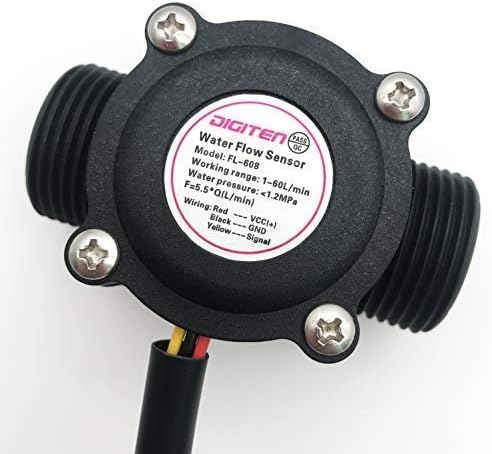
The DIGITEN G1.5" Water Flow Sensor stands out as the top choice with a perfect rating. It handles a broad flow range and features durable materials suitable for drinking water.
We may earn a commission when you buy through this link, at no additional cost to you.
Its high pressure tolerance of 1.75 Mpa ensures reliability in demanding systems like industrial setups. The G1.5 inch BSPT thread supports larger pipe installations without adapters.
While larger and pricier than small sensors, this unit offers unmatched robustness. The trade-off is justified for projects requiring high flow rates and long-term stability.
Buy this if you need a reliable sensor for heavy-duty applications. Its quality justifies the cost for serious makers and professionals.
Withstands up to 1.75 Mpa pressure making it ideal for pressurized water lines.
ROHS compliant materials ensure the sensor is safe for use in potable water systems.
We may earn a commission when you buy through this link, at no additional cost to you.
This model combines precision engineering with a user-friendly design. The integrated hall effect sensor ensures accurate pulse output without external components.
We may earn a commission when you buy through this link, at no additional cost to you.
Sealed components protect the sensor from water damage ensuring longevity. The NPT thread fits standard fittings making it versatile for many setups.
While limited to 30L/min flow it excels in household and light commercial applications. The compact size reduces space requirements in tight enclosures.
Choose this for reliable performance in standard water monitoring tasks. It balances cost and quality effectively for most Arduino projects.
Features an integrated hall effect sensor that outputs pulses for every revolution.
The hall effect sensor is sealed from water to stay dry and safe.
We may earn a commission when you buy through this link, at no additional cost to you.
The DIGITEN G3/8" sensor offers exceptional value for budget-conscious makers. It supports low flow rates ideal for small plumbing systems.
We may earn a commission when you buy through this link, at no additional cost to you.
It operates on a wide voltage range between 3.5 and 12 volts. The square wave output ensures clean signals for microcontroller reading.
This sensor lacks high flow capacity but performs well for minor leaks or slow streams. The compact design fits easily into small enclosures.
Select this for entry-level projects or low-flow applications. It provides reliable data without breaking your budget.
Provides accurate measurement at a fraction of the price of larger models.
Small size makes it easy to install in tight or hidden spaces.
We may earn a commission when you buy through this link, at no additional cost to you.
The DEVMO sensor offers high amplitude output suitable for systems needing stronger signals. It performs reliably in water cooling systems and vending machines.
We may earn a commission when you buy through this link, at no additional cost to you.
Its electric strength ensures durability under varying electrical conditions. The 1-30L/min flow rate covers most standard household water needs.
While it may require specific voltage levels it delivers consistent data. The strong insulation protects against electrical stress in industrial environments.
Use this for projects requiring robust signal strength. It is a solid choice for professional applications.
Features high amplitude output to ensure clear signal transmission.
Electric strength rating of 1250V/min provides reliable insulation.
We may earn a commission when you buy through this link, at no additional cost to you.
This food-grade sensor ensures safety for any project involving drinking water. It uses materials that meet ROHS testing standards for compliance.
We may earn a commission when you buy through this link, at no additional cost to you.
It accepts a wide input voltage range allowing flexible power options. The BSPT male thread connects easily to standard fittings.
While the rating is slightly lower it provides accurate flow measurement. The affordable price makes it accessible for hobbyists.
Choose this for safe and simple water monitoring tasks. It is a practical solution for many home projects.
Constructed with food grade plastic safe for potable water systems.
Operates on a wide 5 to 24 volt input range.
We may earn a commission when you buy through this link, at no additional cost to you.
The transparent valve body allows direct visual observation of water flow. This feature helps users monitor rotor condition without disassembly.
We may earn a commission when you buy through this link, at no additional cost to you.
It includes stainless steel beads for wear resistance in the impeller. The lightweight design makes handling and installation straightforward.
While the rating is moderate the transparent view adds unique utility. It is ideal for educational setups where visibility matters.
Select this when visual feedback is required. It offers a unique advantage over opaque models.
Transparent body facilitates easy observation of water flow conditions.
Impeller internally inlaid with stainless steel beads for longevity.
We may earn a commission when you buy through this link, at no additional cost to you.
Designed for very low flow rates this sensor suits small pipe projects. Its connection matches standard hosepipes with specific inner diameters.
We may earn a commission when you buy through this link, at no additional cost to you.
The food grade material ensures safety for drinking water applications. It operates efficiently under lower pressure conditions.
The small connection limits use to narrow tubing systems. However for precise low flow measurement it performs admirably.
Use this for drip systems or small fluid control tasks. It provides accuracy where larger sensors might fail.
Connects to hosepipes with inner diameter about 5 to 7 mm.
Designed for water pressure up to 0.8 Mpa maximum.
We may earn a commission when you buy through this link, at no additional cost to you.
This unit achieves a perfect rating for its reliability in water heaters and dispensers. It detects influent flow rate through magnetic rotor rotation.
We may earn a commission when you buy through this link, at no additional cost to you.
The hall sensor outputs a pulse signal that the controller reads efficiently. The plastic valve body ensures corrosion resistance in wet environments.
While features are standard its consistent performance stands out. The multiple interfaces allow adaptability across different setups.
Choose this for critical applications where failure is not an option. It delivers steady and accurate flow data.
Magnetic rotor rotates with flow rate changes for detection.
Hall sensor outputs corresponding pulse signal for controller feedback.
We may earn a commission when you buy through this link, at no additional cost to you.
This model includes a 1.2 meter cable for convenient remote placement. It simplifies wiring by eliminating the need for custom extensions.
We may earn a commission when you buy through this link, at no additional cost to you.
The SM2.54 connector ensures secure connection to compatible controllers. It meets ROHS standards for safe drinking water use.
While the cable length is fixed it suits most small installations. The waterproof build ensures reliability in moist conditions.
Buy this for projects needing sensor separation from the controller. It streamlines setup and reduces wiring clutter.
Comes with a 1.2 meter cable for easy remote connection.
Features SM2.54 3P wire connector for stable connections.
We may earn a commission when you buy through this link, at no additional cost to you.
This sensor handles higher flow rates up to 60 liters per minute. The G3/4 inch thread connects directly to larger pipe systems.
We may earn a commission when you buy through this link, at no additional cost to you.
It comes with a 1.2 meter cable allowing flexible placement in your setup. The design resists water and pressure changes.
While the rating is lower it serves well for high throughput tasks. The larger thread size accommodates main water lines.
Choose this for projects needing significant flow capacity. It supports larger systems than smaller models.
Supports flow up to 60 liters per minute for large systems.
Connects to G3/4 inch BSPT male thread directly.
We may earn a commission when you buy through this link, at no additional cost to you.
Selecting the right flow meter depends on several technical and practical factors. Review these elements to ensure compatibility with your project requirements.
The flow rate range determines how much water can pass through the sensor. Match this to your expected usage to avoid saturation or inaccuracy.
Choose a model that covers your minimum and maximum flow needs comfortably.
Sensors have specific voltage requirements for operation. Ensure your power source matches the sensor's specified input range.
Check the datasheet for minimum and maximum voltage limits to prevent damage.
Thread types such as NPT or BSPT must match your plumbing fittings. Verify the thread size before purchasing to avoid extra adapters.
Selecting the correct thread ensures a leak-free and secure installation.
If using potable water check that materials meet food grade or ROHS standards. Non-compliant materials may leach harmful substances into water.
Look for certifications that guarantee safety for drinking water applications.
Hall effect sensors output pulse signals proportional to flow. Verify your Arduino board can handle these signals for accurate reading.
Square wave outputs are generally easier to process with interrupts.
Longer cables allow placing the sensor away from the controller. Check if the cable length suits your physical layout.
Avoid needing extensions by choosing a sensor with sufficient built-in cable.
Pressure ratings indicate the maximum water pressure the sensor can handle. Exceeding this can damage internal components permanently.
Ensure your system pressure stays below the rated limit for longevity.
Sealed and waterproof designs protect electronics from moisture damage. This is crucial for environments with potential splashes.
Choose models with proven water resistance for outdoor or damp installations.
Install the sensor upstream in the pipe where flow is stable and straight. Ensure no air bubbles enter the system during initial testing.
Connect the sensor wires to your Arduino digital pin and power supply. Use pull-down resistors if required to stabilize the signal input.
Periodically check the sensor for debris or mineral buildup. Clean gently with mild solutions to maintain accurate readings.
Most models are rated for cold or ambient water temperatures. Using them with hot water may damage internal seals. Check the temperature rating before application.
Any standard Arduino Uno or Nano can read pulse signals. Ensure the pin supports interrupts for accurate counting during high flows.
Accuracy varies by model and flow conditions but ranges around ±2 to 3 percent. Calibration improves precision over time for consistent results.
Yes many are explicitly designed for reverse osmosis and filtration systems. Ensure flow rates match the system output for optimal performance.
Check flow direction and voltage connections first. Ensure water flows through the pipe correctly to activate the internal rotor.
Installation depends on matching thread sizes like G1/2 or NPT. Use adapters only if they do not restrict flow excessively.
We have reviewed ten top models including the DIGITEN G1.5" for high pressure and the G3/8" for budget needs. Each offers unique advantages for different setups.
Prioritize flow rate range and safety certifications for your specific use case. A sensor with robust build quality lasts longer under regular use.
Always check current pricing and stock availability before buying. Specifications can vary slightly between batches so verify details on the product page.