
Superflex 3D Printer Resin
4.4Editor score
Fast printing capability
Balanced softness
ISO certified safety
This guide compares the top flexible resin for 3D printing options available in October 2026, evaluating their flexibility, durability, and print quality.
Finding the right flexible resin for 3D printing can be challenging due to the variety of materials available. These resins allow you to create parts that bend, stretch, and absorb impact like rubber or TPU. Choosing the correct formulation ensures your prints are durable and functional for real-world applications.
We have analyzed ten leading flexible resins based on their hardness, flexibility, and ease of printing. Our comparison considers factors like shore hardness, elongation at break, and compatibility with LCD and DLP printers. This helps you select the best material for your specific project needs without guesswork.
Each pick in this guide highlights unique strengths such as impact resistance, rebound speed, or budget-friendly pricing. Note that product availability and pricing may change over time. Always check current listings before purchasing to ensure you get the best value for your 3D printing setup.
4.4Editor score
4.7Editor score
4.2Editor score
The following table provides a side-by-side comparison of all ten flexible resins featured in this guide. It highlights key specifications and unique attributes to help you quickly identify which material aligns best with your printing requirements.



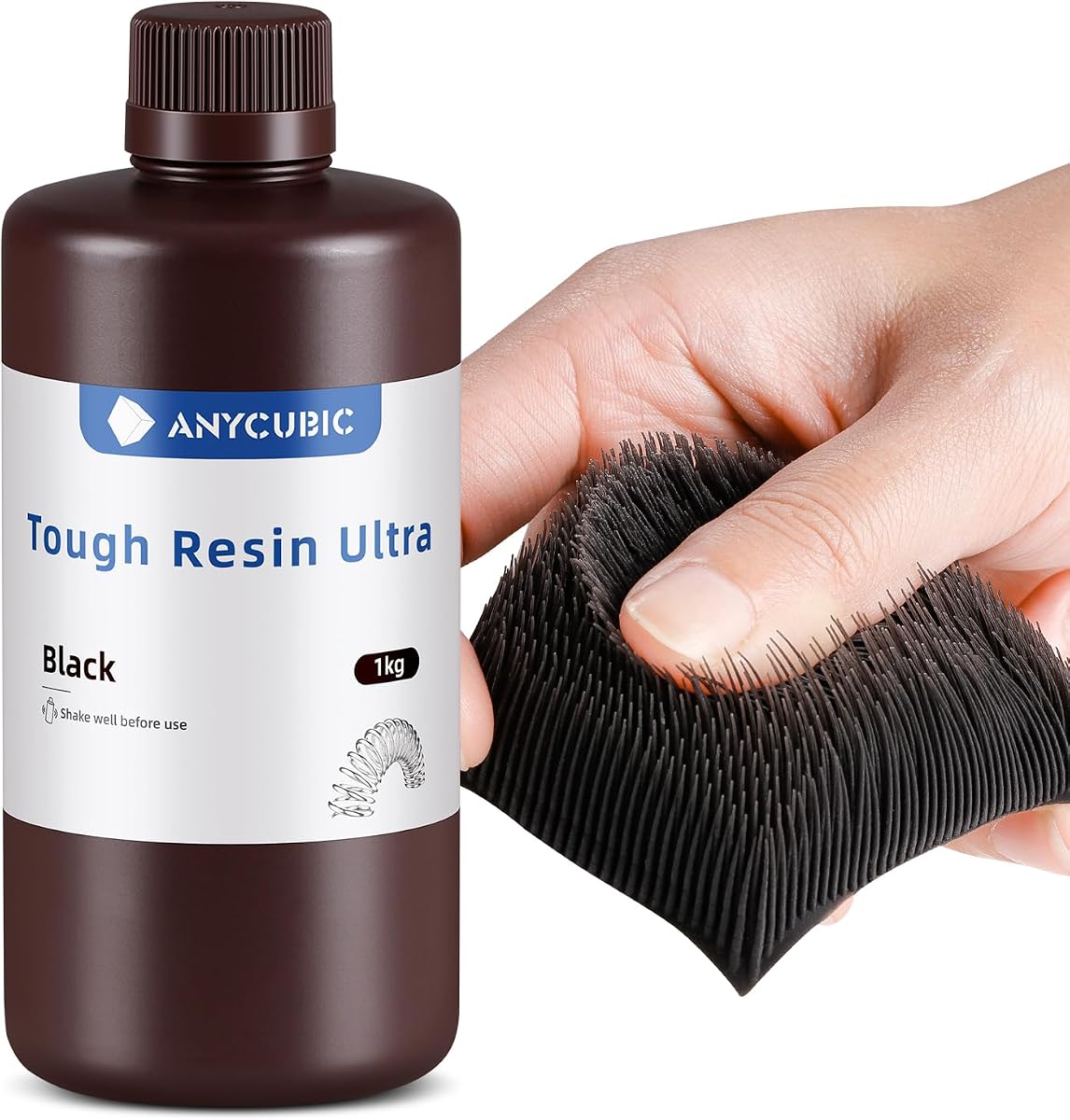
ANYCUBIC Ultra Tough Resin stands out as a top contender for those needing high flexibility and impact resistance. With a strong rating from users, it excels in creating parts that withstand significant stress without breaking. Its unique formulation allows for a gentle touch, making it ideal for wearable items.
We may earn a commission when you buy through this link, at no additional cost to you.
The key strength lies in its ability to recover its original shape after deformation. This property ensures that articulated models move smoothly and earphone covers remain durable over time. It also works well as an additive to enhance the toughness of other resins, adding value to your printing workflow.
One trade-off to consider is that blending it with other resins might alter the final color if not matched carefully. However, when used alone or with matching colors, the impact on appearance is negligible. This minor issue is outweighed by the material's superior performance in demanding applications.
If you need a resin that balances flexibility with strength for daily wearables or functional prototypes, this is the top recommendation. It offers a reliable solution for makers who require parts that can handle repeated stress and impact without failing unexpectedly.
The non-irritating finish ensures comfort when printing items that contact skin directly.
Its ability to absorb shock makes it perfect for protective cases and dynamic parts.
We may earn a commission when you buy through this link, at no additional cost to you.
Superflex 3D Printer Resin offers a compelling option for users seeking a budget-friendly flexible material without sacrificing performance. It features a balanced 80A Shore hardness that simulates rubber properties effectively. This makes it suitable for creating hard flexible prototypes that need cushioning or damping.
We may earn a commission when you buy through this link, at no additional cost to you.
Its standout feature is the fast printing speed, capable of printing 50um layers in just 1.7 seconds on monochrome LCD printers. This significantly enhances productivity for printing farms and individuals looking to minimize time and electricity costs. The material maintains strength while offering flexibility.
While the 500g bottle is smaller than the standard 1kg sizes found elsewhere, it remains a cost-effective entry point for testing. Some users note that clear resins can yellow over time with UV exposure, but this is typical for many photopolymer materials. It is an excellent choice for short-term prototypes.
Choose this resin if you want to optimize your printing speed while keeping costs low. It is particularly well-suited for applications requiring shock absorption or cushioning where high elongation is necessary for the part to function correctly under stress.
Fast layer curing times increase output significantly for high-volume printing needs.
ISO 10993-5 compliance ensures the material meets safety standards for medical testing.
We may earn a commission when you buy through this link, at no additional cost to you.
SUNLU Flexible 3D Printer Resin provides a softer option with a 70A Shore hardness and 135% elongation. This allows for prints that are highly bendable and resistant to breaking upon impact. It is designed to offer a smooth finish with minimal odor during the printing process.
We may earn a commission when you buy through this link, at no additional cost to you.
The low shrinkage rate ensures accurate sizing and shape retention after curing. This precision helps avoid distortion in the printed parts which can be an issue with softer resins. The bottle design is leak-proof, which is a thoughtful addition for storage and transport safety.
One limitation is the gray color only availability which might not suit all aesthetic preferences. Additionally, user feedback suggests it may have a lower success rate compared to premium options. It is a decent choice for standard soft models but requires careful support settings.
If you need a soft resin for general prototyping or functional parts that require bending, this is a solid option. The balance of strength and flexibility makes it capable of withstanding drops without cracking.
Low shrinkage ensures parts retain their original shape and dimensions after curing.
The leak-proof design prevents messes during shipping and long-term storage.
We may earn a commission when you buy through this link, at no additional cost to you.
Siraya Tech Tenacious Flex Black is formulated to be significantly softer and more rubber-like than its predecessor. It offers incredible elasticity and fast rebound which is crucial for parts that undergo compression. The high impact resistance protects models from cracks or deformations.
We may earn a commission when you buy through this link, at no additional cost to you.
This resin excels in applications like gaskets, shock-absorbing components, and soft grips. Its ability to withstand extreme bending makes it a durable choice for dynamic parts. It also works well as an additive to boost the flexibility of tough resins in mixed formulations.
Note that it may not be suitable for all applications where the original Tenacious resin was used due to its softer nature. The 500g size is also smaller than the standard 1kg offerings. However, for specific flexible needs, its performance is exceptional.
Select this resin for projects requiring high flexibility and resilience where the material needs to snap back quickly. It is perfect for prototypes that need to absorb shock or endure repeated flexing without permanent damage.
Fast rebound ensures parts return to their original shape rapidly after compression.
Ideal for creating protective components that need to withstand sudden impacts.
We may earn a commission when you buy through this link, at no additional cost to you.
ANYCUBIC Tough Resin 2.0 is an upgraded formulation designed for high flexural strength and precision. It resists breaking better than previous versions and has low shrinkage for accurate details. The low-odor formulation creates a more comfortable printing environment for users.
We may earn a commission when you buy through this link, at no additional cost to you.
It effectively resists peeling and cracking under stress making it durable for thin models. The material is optimized for various LCD printers and maintains smooth surfaces even in intricate prints. This balance of toughness and precision makes it versatile for industrial parts.
While it is flexible compared to standard resins, it is not as soft as rubber-like options. This makes it better suited for structural parts that need to bend slightly without snapping. It is an excellent choice for makers prioritizing accuracy.
Choose this resin if you need a blend of strength and flexibility for structural components. It is particularly useful for prints that must maintain tight tolerances while still withstanding impact.
Minimal shrinkage ensures parts are manufactured to exact dimensions without deformation.
Reduced volatile organic compounds make it a safer option for indoor printing.
We may earn a commission when you buy through this link, at no additional cost to you.
SUNLU High Toughness 3D Printer Resin is designed for structural parts requiring high durability. It features elongation five times higher than standard resins and low viscosity for better flow. This results in crisp details and reduced distortion during the curing process.
We may earn a commission when you buy through this link, at no additional cost to you.
Its low shrinkage helps prevent cracking after washing and curing, improving overall success rates. The low odor formulation enhances user comfort during printing. It is widely compatible with most LCD and DLP printers on the market.
This material is better suited for structural components than soft rubber-like items. It provides a rigid yet flexible balance that resists permanent deformation under load. This makes it ideal for mechanical parts needing strength.
Opt for this resin if you need durable structural components that resist breaking. The high performance in accuracy and toughness makes it a reliable choice for demanding functional models.
Low viscosity ensures smooth layer flow and reduces printing defects.
Five times toughness increases the lifespan of printed parts under stress.
We may earn a commission when you buy through this link, at no additional cost to you.
ELEGOO Tough 3D Printer Resin Black is built for durability and structural integrity. It offers high elasticity and resilience which helps it withstand tension and stress without breaking. The Shore hardness is 84.7D, which is higher than soft resins but still flexible.
We may earn a commission when you buy through this link, at no additional cost to you.
The material resists corrosion and softening even in humid environments making it suitable for outdoor or industrial use. Its fine texture allows for drilling without cracks which is a common issue with brittle resins. This makes it ideal for functional tools and jigs.
It is less flexible than rubber-like options but provides superior toughness. The black color is standard for engineering prints where aesthetics are secondary. It offers a comfortable printing experience with low odor.
Choose this resin for end-use products or tools that must withstand wear and tear. Its robust physical properties make it a solid choice for projects requiring mechanical strength.
High resistance to humidity and corrosion ensures reliability in challenging environments.
Parts can be post-processed by drilling without risking cracks or splits.
We may earn a commission when you buy through this link, at no additional cost to you.
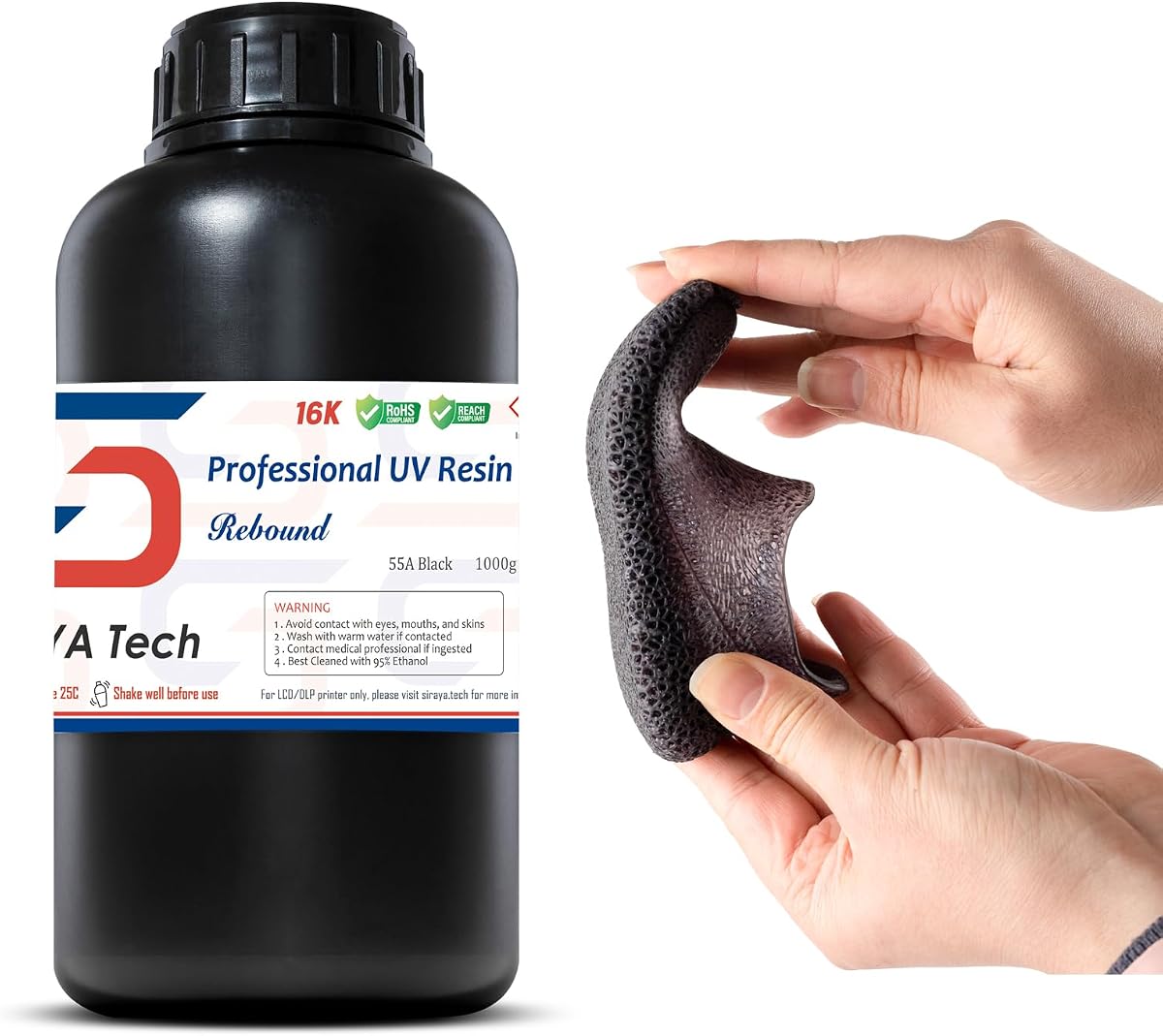
Siraya Tech Rebound 55A offers high elasticity with a 55A Shore hardness softer than Tenacious Flex. It provides significantly faster rebound than standard elastic resins which is key for dynamic components. It balances flexibility with structural integrity for shock absorption.
We may earn a commission when you buy through this link, at no additional cost to you.
Unlike other elastomers, it prints on standard LCD and DLP printers without mixing or complex processing. Cleaning is straightforward using standard alcohol methods. This simplifies the workflow significantly for makers seeking soft prototypes.
The material is ideal for protective equipment or industrial prototypes requiring rapid shape recovery. Initial testing shows resilience though long-term testing is ongoing. Its elasticity is higher than most options listed here.
Use this resin for applications where quick shape recovery and high elasticity are critical. It stands out for prototyping seals and gaskets needing to compress and spring back effectively.
Standard IPA cleaning works without specialized chemicals or mixing steps.
High rebound speed ensures parts recover quickly after compression cycles.
We may earn a commission when you buy through this link, at no additional cost to you.
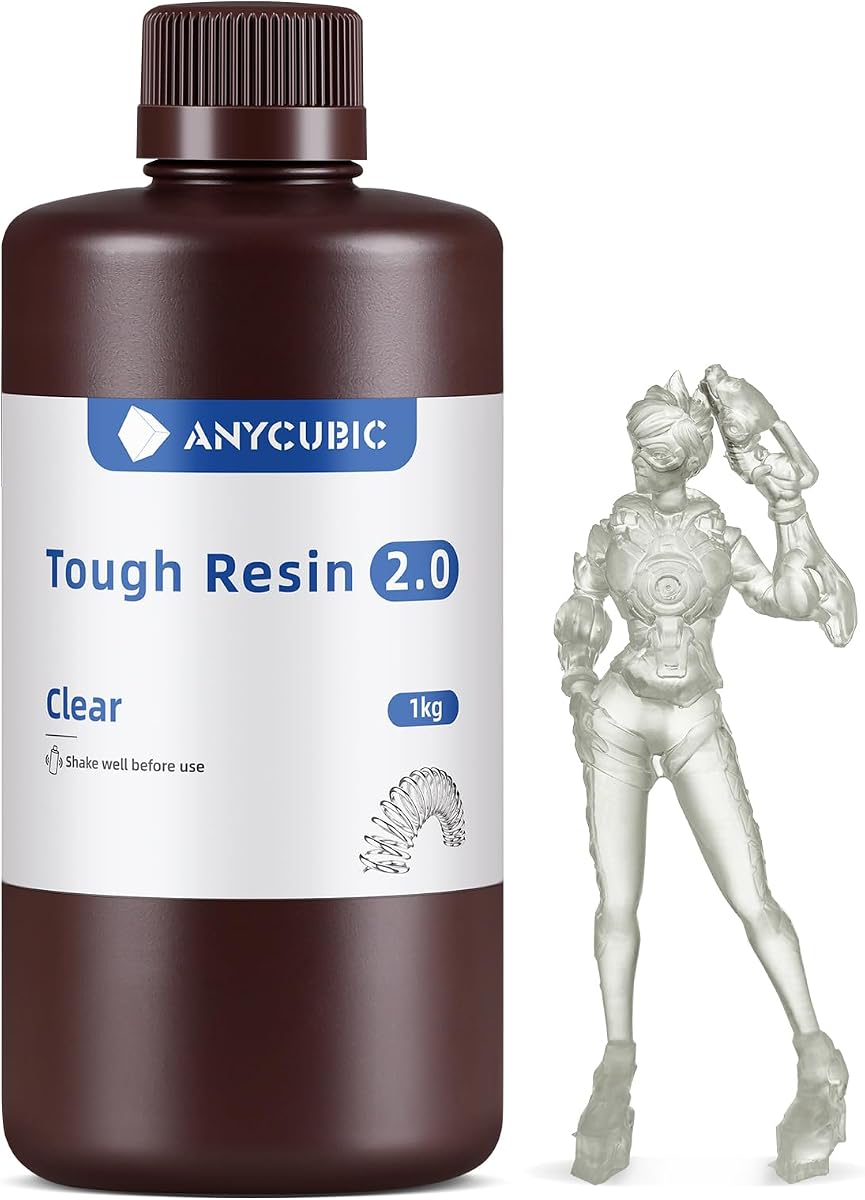
ANYCUBIC Tough 3D Printer Resin 2.0 comes in a clear variant offering unmatched strength. It enhances flexural strength significantly making it resistant to breakage even in thin parts. The exceptional stretch helps resist damage from cyclic vibrations.
We may earn a commission when you buy through this link, at no additional cost to you.
It maintains high precision with minimal shrinkage which ensures clean details in transparent parts. The low-odor formulation is pleasant for indoor use. This makes it a versatile choice for both industrial and consumer applications.
The clear finish allows light transmission but may require careful curing to avoid yellowing. It is well-suited for cases or transparent enclosures needing durability. The flexibility remains good for handling stress without failure.
Opt for this version if you need transparent tough parts with flexibility. The combination of clarity and strength is rare and highly valued for protective casings.
Clear variant allows for visual inspection or aesthetic transparent designs.
Upgraded formula prevents bending or breaking under mechanical load.
We may earn a commission when you buy through this link, at no additional cost to you.
This resin simulates the toughness of rubber with a 90A Shore hardness. It can be folded repeatedly without breaking thanks to high elongation and tear resistance. It is suitable for cushioning and shock absorption tasks requiring structural integrity.
We may earn a commission when you buy through this link, at no additional cost to you.
It delivers crisp and accurate prints with a low-odor formula. The material holds up well under repeated stress without wearing out or tearing. It is compatible with most LCD and DLP printers for easy adoption.
While it is not as soft as 70A or 55A options, it offers better durability for high-wear parts like toy tires or soles. It balances toughness with flexibility effectively. This makes it a practical choice for rugged applications.
Choose this resin for functional parts that need to endure physical abuse and repeated folding. Its high precision ensures detailed designs remain intact while retaining flexibility.
High elongation and tear resistance ensure parts last longer under stress.
Crisp prints ensure detailed parts remain accurate while maintaining strength.
We may earn a commission when you buy through this link, at no additional cost to you.
Selecting the right flexible resin involves balancing flexibility, toughness, and ease of printing to suit your needs.
Shore hardness defines how soft or firm a printed part feels. Lower values like 55A are very soft and rubbery while higher values like 80A or 90A offer more structure.
Check the hardness rating to ensure it matches the flexibility level required for your project application.
Elongation at break measures how far a material can stretch before it tears. Higher elongation means the part can bend more without snapping permanently.
Look for resins with at least 100% elongation for parts that need to flex under significant stress.
Impact resistance determines how well a print withstands drops or collisions. Tough resins absorb energy and recover shape rather than shattering.
Prioritize impact resistance for protective cases, bumpers, or tools subject to heavy use.
Curing time affects your printing speed and efficiency. Fast curing resins allow for quicker layer completion and reduced printing duration.
Select resins optimized for fast curing to maximize your printer's throughput.
Not all resins work with every printer. Ensure the resin is compatible with your printer's wavelength and screen technology.
Check specifications for LCD, DLP, or SLA compatibility to avoid print failures.
Available colors vary by brand and formula. Some options come in clear, black, gray, or white.
Choose a color that fits your visual requirements or consider how the resin ages over time.
Tear resistance ensures printed parts resist rips or splits during repeated use. It is essential for items that undergo constant bending.
Look for high tear resistance ratings for applications involving continuous motion.
Low odor formulations improve the indoor printing experience and reduce health risks. Safety certifications ensure the material is safe to handle.
Opt for low odor and certified materials for comfortable and safe printing.
Always shake the resin bottle gently before printing to mix any settled particles. Ensure the printer tank is clean and level to avoid defects in soft prints.
Use standard isopropyl alcohol for washing and a UV curing station for post-curing. Flexible prints may need longer curing times to achieve full toughness.
Store resin in a cool dark place to prevent accidental curing. Avoid prolonged exposure to direct light during storage to maintain stability.
Flexible resin is soft and rubbery with high elongation allowing for bending without breaking. Tough resin is harder and resists cracking under stress but may not bend as much as flexible resin.
Flexible resins typically require standard alcohol washing and UV post-curing. However, they may need slightly longer curing times to ensure full structural integrity and durability.
Yes, flexible resin can be mixed with standard resin to add elasticity. Start with small amounts to test how it affects the final hardness and color of the print.
LCD and DLP printers are best for flexible resin because they offer precise control. Ensure your printer supports 405nm wavelength for proper curing of photopolymer resins.
Properly cured flexible resin is generally safe to touch. However, always wash and cure parts thoroughly to remove any uncured material before handling them.
Failures often occur due to supports being too rigid or curing times being too short. Adjust your support settings and ensure full post-curing for better results.
Use warm isopropyl alcohol and a soft brush to remove residue. If they remain sticky, extend the UV curing time to ensure the resin fully polymerizes and hardens.
Shore hardness is a scale measuring material stiffness. Lower numbers indicate softer rubbery materials while higher numbers represent firmer plastics or rigid resins.
In summary the top flexible resins offer a range of hardness and toughness options. ANYCUBIC Ultra Tough Resin leads for versatility and comfort while Superflex offers speed on a budget.
For high elasticity and rebound Siraya Tech Rebound 55A stands out for specialized prototyping. Selecting the right material depends on the specific needs of your project.
Always verify current prices and availability as product details can change. Choosing the best resin ensures your prints are functional durable and ready for real-world use.